


Phonics is a foundational aspect of early literacy, helping young children decode words, recognise patterns, and eventually develop a love for reading. For Early Years Foundation Stage (EYFS) children, progression in phonics happens gradually, focusing on building skills in a structured, engaging, and playful way.
I have identified 7 steps that children need to achieve before they get to this final stage of reading. In each step, children need to listen to increasingly smaller units of sound. In this blog, I aim to go through each one and suggest activities which can support each stage. If you are familiar with the ‘letters and sounds phase 1‘ document, the activities will also support in teaching a number of activities outlined there.
Don’t miss out! At the bottom of the page there is a free booklet which will help you to identify the gaps in your children’s phonics knowledge.

So let’s dive into the stages of phonics progression for early years and some key Early Years phonics activities teachers and parents can use to support children in their phonics journey.
Table of Contents
Early Years Phonics Activities 1 – Listening Skills

Listening is a very tricky skill that children need to learn. Hearing is the process of receiving sound waves through the ear while listening requires concentration so that your brain processes meaning from what is being heard. That concentration can be developed in a number of ways:
- Read and discuss stories
- Conversations and Questioning
- Give instructions for children to follow, increasing in complexity
- Play listening games (see below)
Listening Games

- Close your eyes and listen to what sounds you can hear
- Go on a sound walk and listen for sounds in the environment
- Find a hidden ticking clock by listening to the sound and follow where it is coming from
- Sound lotto
- Play online listening games
Early Years Phonics Activities 2 – Rhymes


Rhyming again, isn’t an easy skill for children to develop. Children will need to hear lots of different rhyming words in lots of different ways to tune their ears to rhyme. The following activities will support in developing this skill:
- Sing nursery rhymes
- Read rhyming stories, emphasising the rhyme, eventually missing out the rhyming words for the children to complete
- Play rhyming pairs, where children need to match picture cards
- Say a rhyme and the child suggests the rhyming words e.g. ‘This cat wears a …’, ‘That big bear has brown …’
- Play online rhyming games
Visit my shop to get a copy of my number songs and rhymes pack containing 15 rhymes.
Early Years Phonics Activities 3 – Words

Children need to recognise that language is made up of component parts i.e. words, and see them as separate parts. The following activities will support with this.
- Point out the print when reading a story
- Write out a sentence e.g. I went to the park. Circle each word as you read it
- Put down a block for every word that you say in a sentence. Count how many words you used. Let some of the children have a turn once they are familiar with the activity.
- Play missing word games e.g. I went to the shop and bought a …
Early Years Phonics Activities 4 – Syllables

Even smaller than the words themselves are the units which make up a word – syllables. Once children can do a number of the activities above, they will be ready to tune into these smaller parts. The activities below will help with this.
- Use an instrument to beat the children’s names.
- Choose picture cards or objects and clap the syllables.
Early Years Phonics Activities 5 – Phonemes

At this stage, the children are ready to learn to listen for letter sounds. There are 26 letter sounds to learn and they combine in various ways to make 44 phonemes and so it is important that the children have a solid foundation in the previous skills
- Play ‘I spy with my little eye’.
- Have a bag of three objects two of which have the same sound. Children say each object and find the ones with the same sound.
- Split words into their component phonemes. Children put the sounds back together to hear what word you are saying e.g. Touch your t – oe – s
Early Years Phonics Activities 6 – Sound and Letter Relationships


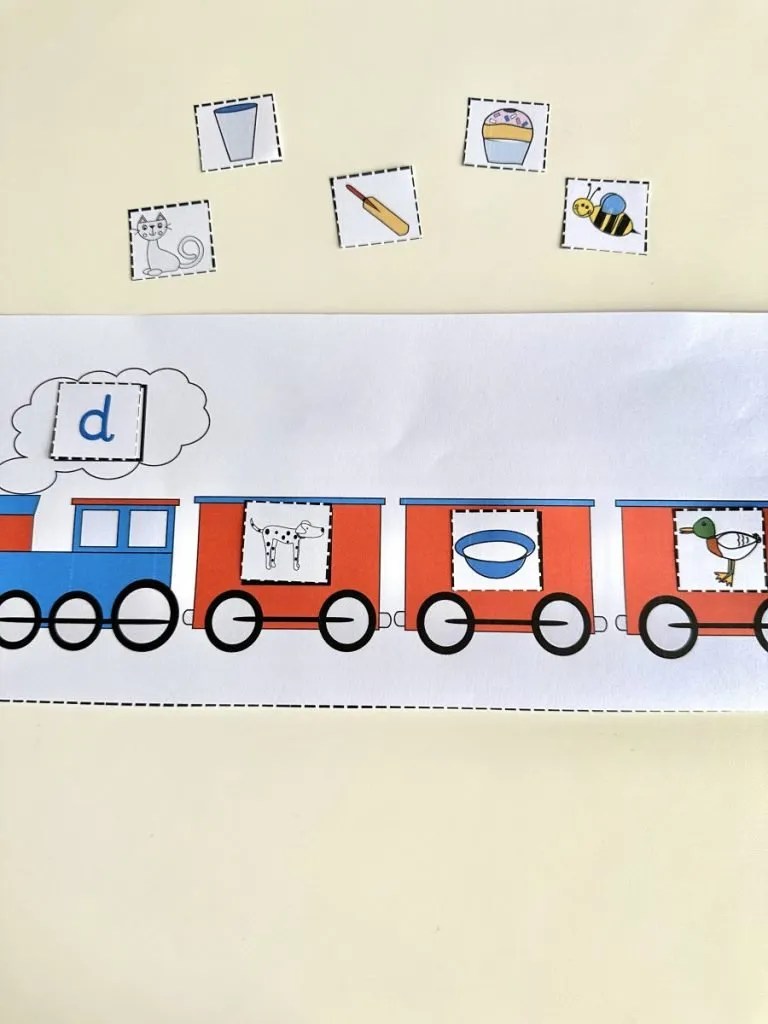
This next stage involves the children making links between sounds and letters – they understand that certain letters make certain sounds. Activities that will help children to understand the correspondence between the two are as follows:
- Systematic, synthetic phonics programme
- Sound cards
- Magnetic letters and boards
- Interactive games
- Sound Clip Cards
- Digraph worksheets
- Sound Train
Early Years Phonics Activities 7 – Blending and Segmenting
Segmenting is the process of breaking words down into their component parts and is a particular important skill for writing as children hear what sounds they need to write a word.
Blending is the opposite of segmenting as it takes each sound and puts them back together to make a word. Once children can do this skill, they will be able to read. Learning to blend can be tricky and can sometimes take lots of time and practice.


Children will need to learn how to orally blend before they will be able to blend using the grapheme/phoneme correspondence. Metal Mike is a robot introduced in the letters and sounds phase 1 document and can be used to support with this. There is one to cut out and laminate in my pack.
Blending in lots of different ways with lots of different activities will really help your child to develop this skill. Using words which have a long vowel sound will help initially. For example, it is much easier for children to learn how to blend the word ‘moon’ than it is the word ‘mug’. This is because there is more for them to hear in the word ‘moon’ than the word ‘mug’.


Get a copy of my blending games pack which includes oral blending bingo, oral blending cards and word blending. There are lots of examples of words with long vowel sounds in them to help them on their way!
Don’t forget to visit my shop to get a copy of my other phonics activities.
Free Progression in Phonics Booklet
The phonics progression booklet can be used in a number of ways. It can either be used to assess where children are at in terms of their phonics development in order to determine appropriate activities to further this development or it can be shared with parents so that they can best support their children’s progression in phonics.
Visit my other blogs for more information on phonics and writing.